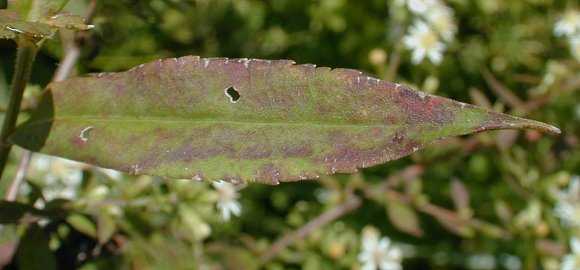
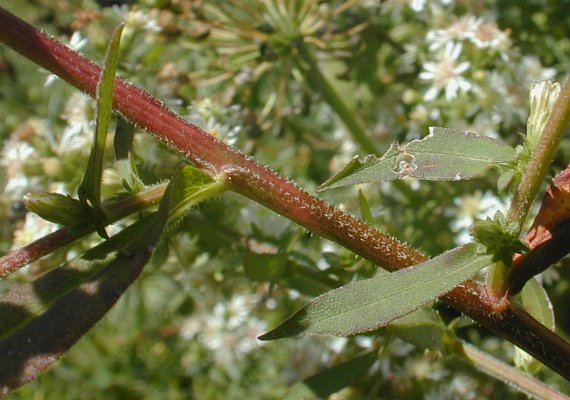
Description: This is a perennial plant about 1-3' tall that branches occasionally, often leaning toward one side. The stems are light green or reddish brown, and they have lines of white hairs. The alternate leaves are up to 4½" long and ½" across, becoming much smaller as they ascend the stems. They are narrowly lanceolate, oblanceolate, or elliptic, becoming linear near the flowerheads. There are usually a few teeth toward the tips of the larger leaves, otherwise they have smooth margins. Some hairs may be present along the major veins on the undersides of the leaves. The upper leaf surface is medium green, while the lower leaf surface is light green. The upper stems and some of the side stems produce panicles of flowerheads up to 10" long and 6" across. Each flowerhead has numerous small disk florets that are surrounded by about 8-12 ray florets. The corollas of the disk florets are initially pale yellow, but they later become brown or reddish purple; they are short-tubular in shape and 5-lobed. The petaloid rays are white and linear-oblong in shape. A typical flowerhead is about 1/3" (8 mm.) across. Each flowerhead is subtended by small green bracts (phyllaries) that are appressed together, or they are only slightly spreading.
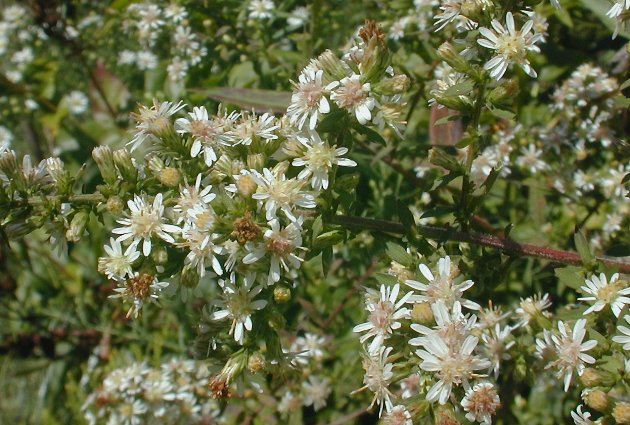
The blooming
period occurs from late summer to the
fall, lasting about 1-2 months. There is little or no floral
scent. The small achenes are slightly pubescent and they have small
tufts of
white hair. Distribution of the achenes is by wind. The root system is
fibrous and rhizomatous; an older plant may develop a small caudex.
Clonal offsets occasionally develop from the rhizomes. This plant
occasionally forms colonies at favorable sites.
Cultivation:
The preference is light shade to partial sun and moist conditions. Full
sun is tolerated if the site is not too dry. Growth is best in rich
organic soil, or a moisture retaining clay-loam. During dry weather,
the lower leaves often wither away, and stressed out plants are
vulnerable to many kinds of foliar disease.
Range &
Habitat:
The native Calico Aster occurs in most counties of Illinois, where it
is native and quite common (see Distribution
Map). Habitats include moist meadows near woodlands and
rivers, floodplain forests and flatwoods, woodland borders, seeps and
swamps, semi-shaded sloughs near fields, and moist depressions in waste
areas. This plant is primarily a woodland species, but it often strays
into moist sunny areas nearby. It prefers areas with a history of
disturbance.
Faunal Associations:
The florets of Calico Aster (Symphyotrichum lateriflorum) have shorter
nectar tubes than many other
species of asters (Symphyotrichum spp.), and they seem to attract a
wide variety of insects,
particularly in sunny areas. Insects that have been observed to visit
the flowerheads of this aster for nectar and/or pollen include
honeybees, bumblebees, little carpenter bees (Ceratina spp.),
leaf-cutting bees (Megachile spp.), Halictid bees (including green
metallic bees), plasterer bees (Colletes spp.), masked bees (Hylaeus
spp.), Andrenine bees, dagger bees (Heterosarus spp.), Crabronid wasps,
Sphecid wasps, Vespid wasps, spider wasps (Pompilidae), Syrphid flies,
Tachinid flies, Muscid flies, Calliphorid flies, butterflies, moths,
beetles, and plant bugs (Robertson, 1929; Graenicher, 1909; Wilhelm
& Rerciha, 2017). Other insects feed destructively on the foliage,
sap, and other parts of asters. These species include leaf beetles,
weevils, larvae of tumbling flower beetles, larvae of leaf-miner flies,
larvae of gall flies, plant bugs, aphids, mealybugs, grasshoppers,
katydids, larvae of twirler moths (Gelechiidae), larvae of Geometer
moths, larvae of owlet moths (Noctuidae), larvae of Tortrix moths, and
larvae of two butterflies, the Silvery Checkerspot (Chlosyne nycteis) and Pearl Crescent (Phyciodes tharos). See the Insect Table and Moth Table
for more information about these species. Some vertebrate animals use
asters as sources of food. The American Tree Sparrow and Ruffed Grouse
feed on the seeds of these plants; the latter bird also feeds on the
leaves. Some herbivorous mammals browse on the foliage of these plants,
including Elk, White-tailed Deer, Cottontail Rabbit, and domesticated
livestock (Martin et al., 1951/1961; Schneider et al., 2006; personal observations).
Photographic
Location:
The photographs were taken at the webmaster's wildflower garden in
Urbana, Illinois.
Comments:
This aster is more attractive in woodland areas, where it has a
delicate appearance. It closely resembles Symphyotrichum
pilosum (Frost Aster), Symphyotrichum ericoides
(Heath Aster), and other species in the genus with small white
flowerheads. The Calico Aster (Symphyotrichum
lateriflorum) is a somewhat lanky plant with smaller
flowerheads (about 1/3" or 8 mm. across) and fewer ray florets per
flowerhead
(about 10) than many similar asters (Symphyotrichum spp.).
In
this regard, it is similar to the Heath Aster, but the latter species
is a more compact plant with leaves that are shorter and more narrow
than those of the Calico Aster. While the Heath Aster is often found in
open prairies, the Calico Aster usually doesn't stray far from woodland
and semi-shaded wetland areas. Its common name refers to the
diverse colors of the disk florets as they mature. Another common name
of this species is the Side-Flowering Aster, and another scientific
name is Aster
lateriflorus.