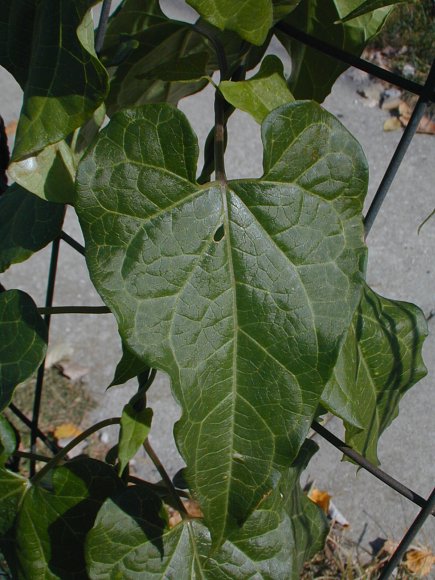
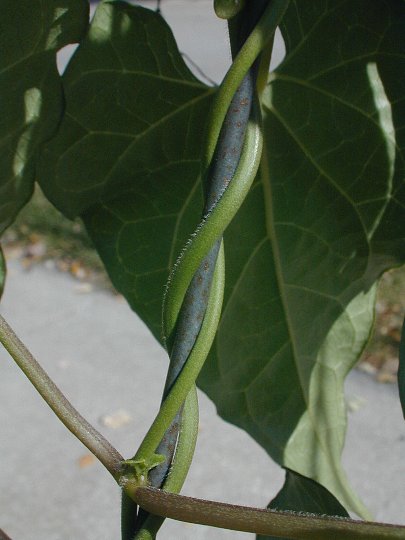
Description: This perennial vine is up to 15' long and non-woody. The stems twine about adjacent vegetation and fences, climbing upward toward the light. These stems are light green or light reddish green, round in circumference (terete), and shiny; they often have lines of fine white hairs. Opposite leaves up to 6" long and 2½" across occur at intervals along the stems. They are triangular-cordate, glabrous, and dark green. Their margins are smooth, but sometimes undulate up and down. The sinus of the leaf blade is indented and somewhat flattened. The petioles are up to 3" long and often reddish green. A milky sap is absent from the foliage. From the axils of the middle to upper leaves, there are small clusters of flowers about ¾-1½" across on peduncles 1-3" long. Each flower is white or pinkish white and up to ¼" long.
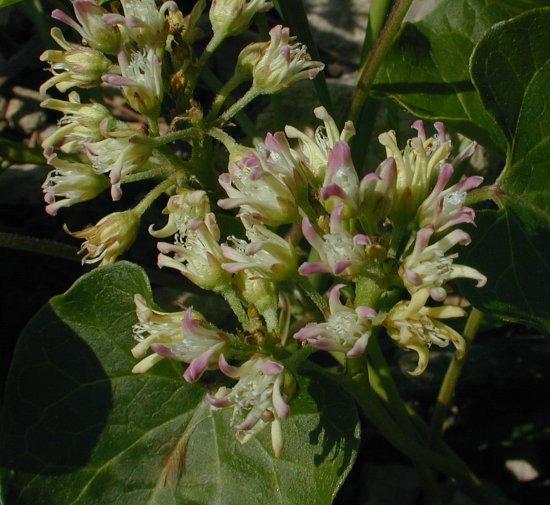
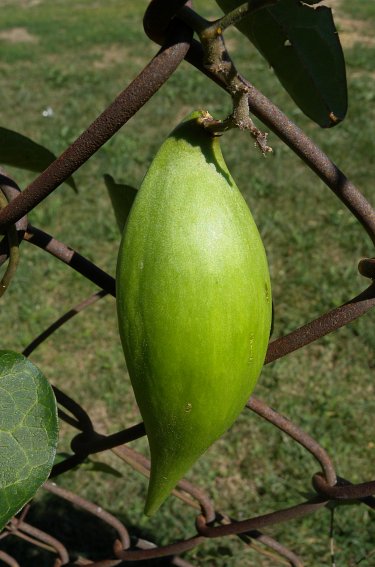
The structure of each flower consists of a light green calyx with 5 lanceolate lobes, a white corolla with 5 linear lobes (sometimes with pink tips), and a white corona (or crown-like appendage) surrounding the reproductive organs in the center. The lobes of the corolla are semi-erect and rather twisted. The corona is divided into 5 segments; each segment has 2 linear extensions at its apex that are rather membranous and twisted. The blooming period occurs from mid-summer to early fall and lasts about 1-2 months. The flowers have a strong honey-like fragrance. If cross-pollination of a flower occurs, there develops a smooth follicle up to 4" long and 1" across; it is lanceoloid and tapers gradually to a point at one end. This follicle is initially green, although it laters becomes reddish green and finally brown. When the follicle splits open along one side, it releases numerous seeds. Each seed has a large tuft of white hairs, which enables distribution by the wind. The root system consists of a taproot and long rhizomes. This vine reproduces by clonal offsets or by reseeding itself.
Cultivation:
The
preference is full or partial sun, and mesic to dry conditions. Almost
any kind of soil is tolerated, including those that contain loam, clay,
gravel, or sand. Bluevine can be difficult to get rid off because new
shoots can develop from the root system after the entire vine has been
pulled. The seeds don't germinate until late spring or early summer.
Range & Habitat:
The native Bluevine is occasional to locally common in southern and
central Illinois, while in northern Illinois it is uncommon or
absent (see Distribution
Map). Habitats include thickets, banks of rivers and drainage
ditches, gravelly areas along railroads and roadsides, cropland,
overgrown vacant lots, shrubbery in yards, and fence rows. Bluevine
adapts quite well to disturbed habitats and it is rather weedy.
Faunal
Associations:
The nectar of the flowers attracts Halictid bees, masked bees (Hylaeus spp.),
wasps, flies, and Monarch butterflies. Among the flies, are such
visitors as bee flies (Bombyliidae), thick-headed flies (Conopidae),
Tachinid flies, and bottle flies. Caterpillars of the butterfly Danaus
plexippes (Monarch) feed on the foliage, while Aphis
nerii (Milkweed Aphid) sucks juices from the foliage. Another
insect, Labidomera
clivicollis (Swamp Milkweed Beetle) also reportedly feeds
on the foliage (Clark et al., 2004).
Mammalian herbivores avoid consumption of the foliage because of its
bitter taste and poisonous properties.
Photographic Location:
The photograph of the flowers was taken near a railroad in
Champaign, Illinois, while photographs of the foliage and seedpod were
taken at a fence row near the webmaster's apartment complex in Urbana,
Illinois.
Comments: Bluevine is often referred to as Cynanchum laeve; its scientific name has changed occasionally through the years. Other common names for this species are Honeyvine and Sandvine. A few members of the Milkweed family in Illinois are twining vines, rather than erect herbaceous plants. Most of these occur in southern Illinois in swampy habitats; they are currently classified as Matelea spp. (Climbing Milkweeds), although they were assigned to the Gonolobus genus in the past. Climbing Milkweeds have larger flowers with spreading corolla lobes; they are variously colored. The flowers of Bluevine are smaller with more erect corolla lobes. An introduced species, Vincetoxicum nigrum (Black Swallow-Wort), occurs occasionally in Illinois. It was formerly known as Cynanchum nigrum. Black Swallow-Wort has leaves that are rounded at the base and its flowers are brownish purple. All of these vines produce follicles (seedpods) that resemble those of other members in the Milkweed family.